 |
| Source: Scholastic Art Magazine, September 2012 |

This blog features resources, reviews and inspiration in the Visual Arts. Check out past projects and examples from my teaching career and my art venture www.artesteem.com that offers private art lessons and mentoring in Manhattan.
Wednesday, September 12, 2012

Tuesday, September 11, 2012
Long-Lost Picasso Discovered and Too Expensive to Keep
Check out the story... "In the southwestern Indiana town of Evansville, people are a bit baffled after hearing that the town's Museum of Arts, History and Science
has had a rare Pablo Picasso piece in storage for almost half a
century. Curator Mary Bower says the work went unnoticed because of a
clerical error."
http://www.npr.org/2012/09/10/160132025/for-museum-long-lost-picasso-is-too-costly-to-keep
http://www.npr.org/2012/09/10/160132025/for-museum-long-lost-picasso-is-too-costly-to-keep
Tuesday, August 28, 2012
2012-2013 School Year
Studio
Art: Grade Six and Seven
 Rubrics and assignments can
be found on www.eboard.com
Rubrics and assignments can
be found on www.eboard.com
Overview
Studio Art is a full-year course that meets every other day for 40
minutes and follows the alternating A/B schedule for the entire school year. Grade
6 and 7 students explore materials and the art making process, art literacy,
making interdisciplinary connections, art history and careers in the arts in a
hands-on studio environment. The
curriculum for grade 6 and 7 follows The Blueprint for the Arts developed for
New York City and is aligned with National Art Education Standards. The
sequence of skills, techniques and projects we explore in class build a strong
art education foundation and makes valuable interdisciplinary connections.
My philosophy is to
cultivate students individual art aesthetic and build on their analytic and
problem solving ability that will challenge and enable students to develop a
full range of tools to utilize in their personal expression in the visual arts.
The Art Department produces annual art exhibitions to celebrate student work
and achievement and students have opportunities to compete in art competitions
outside of school like the Scholastic Art awards.
Grade 6 and 7 artwork will
be showcased on this website, as well as resources and standards in art
education. Visiting this website is a great way to see
what your child is learning in class and see examples of projects created in
class.
 Rubrics and assignments can
be found on www.eboard.com
Rubrics and assignments can
be found on www.eboard.com
All grade 6 and 7 students
are required to have a sketchbook throughout the year for drawing and taking
notes, which is checked periodically in class and part of a students grade. Students
can store their art supplies in the classroom and are expected to have their
sketchbooks with them in class. Larger art projects are graded based upon
rubrics developed for each project, which is handed out to students. This
allows students to see the criteria they need to complete in order to achieve
success. There is homework assigned in Studio Art class but the majority of the
artwork is created and completed in class. Lastly, students have jobs and
responsibilities in the Studio Art room that is part of their daily grade for
participation and performance in class.
Monday, May 21, 2012
Landscape paintings in the style of the Impressionists
 |
| Painting by Dea E., Grade 6 |
Grade six students learned the fundamentals of painting and used a variety of
Impressionistic techniques to create these richly textured, colorful
paintings. Students studied Impressionism, a 19th century art movement made up of Paris-based artists whose independent exhibitions brought them to fame in the 1870s and 1880s. We learned about the movement and analyzed the paintings of Claude Monet, whose painting Impression, Sunrise sparked the use of the term Impressionism because it used very loose brush strokes, which suggested rather than delineated.
Students created landscape paintings in the style of the Impressionists and used a photo as a reference image. Students learned how to use complimentary colors to make browns, as well as how to accentuate highlights and shadows, create atmospheric perspective and work wet paint into wet paint. Additionally, students repeated brushstrokes and learned how to control brush flow and pressure.
Students created landscape paintings in the style of the Impressionists and used a photo as a reference image. Students learned how to use complimentary colors to make browns, as well as how to accentuate highlights and shadows, create atmospheric perspective and work wet paint into wet paint. Additionally, students repeated brushstrokes and learned how to control brush flow and pressure.


 |
| Painting by Rose H., Grade 6 |


 |
| Project Rubric |
Thursday, March 29, 2012
Grade 6: Impressionism
Students studied Impressionism, a 19th century art movement that began as an association of Paris-based artists whose independent exhibitions brought them to prominence in the 1870s and 1880s.The name of the movement is derived from the title of the Claude Monet’s work, Impression, Sunrise that used very loose brush strokes, which suggested rather than delineated.

Artist: Claude Monet Completion Date: 1873
Students incorporated characteristics of Impressionistic painting into their projects that included: short, thick strokes of paint, wet paint was placed into wet paint, natural light was emphasized and ordinary subject matter of everyday life was captured.
Here are photos from class while they are working on their paintings. Students used photos for reference and used Tempera paints to create their paintings, which are a work-in-progress

 |


Wednesday, March 28, 2012
Grade 6: Color Mixing and Color Theory
Students studied the color wheel and created their own with Tempera paints to start off their painting unit in Studio Art. Through a variety of painting exercises, students became familiar with the medium and learned how to control flow of paint and how to use the brush in a variety of ways to create impressionistic-like marks. Additionally, students learned basic color theory and made examples for their sketchbooks.
 |
| Grade 6 Sketchbook Sample |
 |
| Grade 6 Sketchbook Sample |
Students did the following exercises in class:
1. Paint it Black – Created washes and experimented with brushes only using black paint
2. How to mix Tertiary Colors
3. How to make Tints and Shades of a color
4. How do I make Brown?
5. Create a Color Wheel
1. Paint it Black – Created washes and experimented with brushes only using black paint
2. How to mix Tertiary Colors
3. How to make Tints and Shades of a color
4. How do I make Brown?
5. Create a Color Wheel
Thursday, March 8, 2012
Grade 7: Take a Seat, Exploring Chair Design
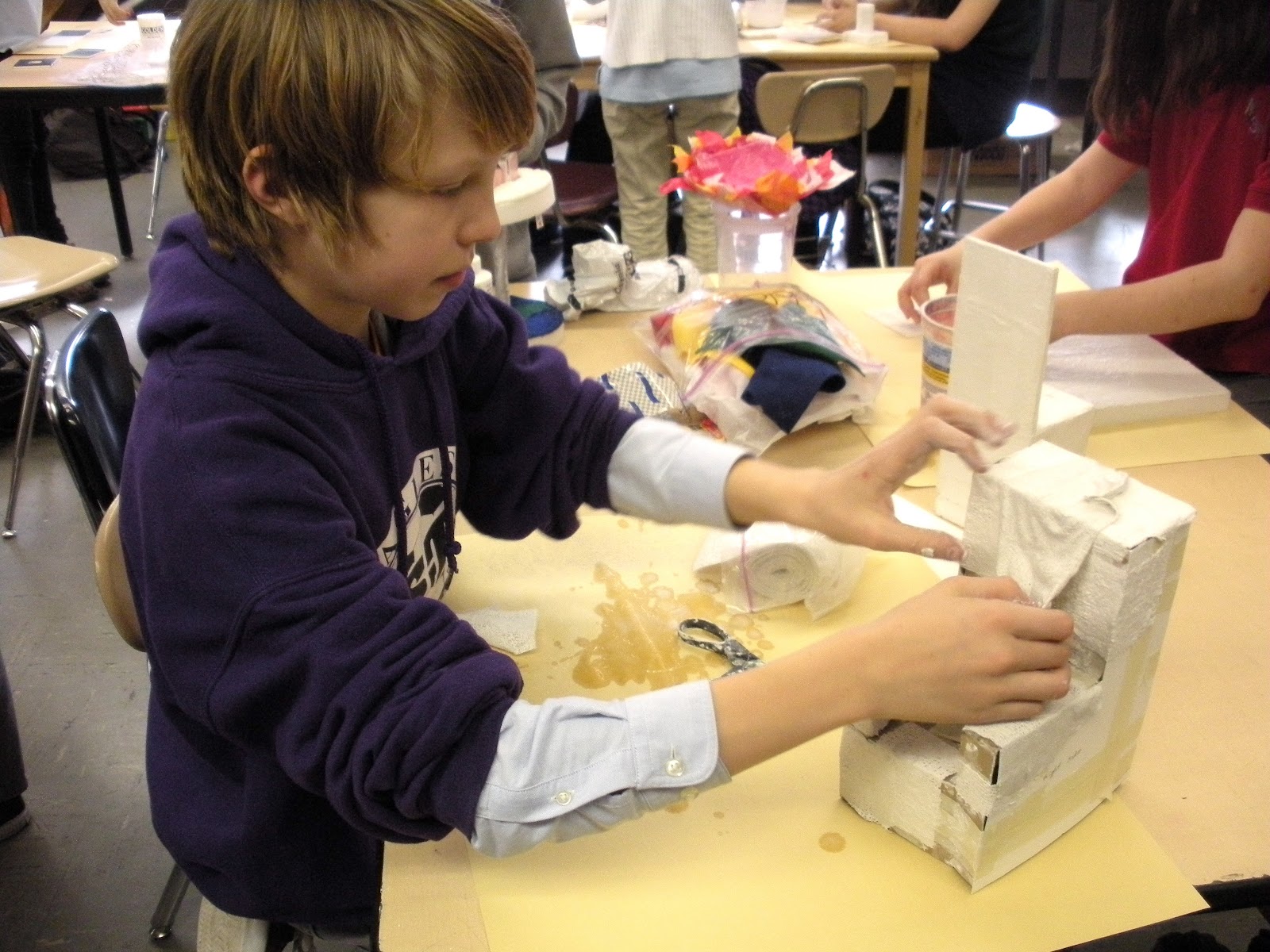
Students are designing a chair based on a concept generated by creating a list of people, places, books, objects, and ideas that inspire them. Additionally, students learned about the history of chair design and notable designers over the past 500 years.
Next, students will create a model of their chair design and explore form, function, balance and a variety of sculpture materials. Here are some pictures from class where students are in the process of building their armatures. Students are using miter saws, plaster, balsa and plywood, cardboard, wire and other found object materials to make these unique and unusual
chair designs.
Next, students will create a model of their chair design and explore form, function, balance and a variety of sculpture materials. Here are some pictures from class where students are in the process of building their armatures. Students are using miter saws, plaster, balsa and plywood, cardboard, wire and other found object materials to make these unique and unusual
chair designs.
 |
 |




Subscribe to:
Posts (Atom)