Thursday, October 18, 2012

Grade 6: Space and Shape in Your Composition

During the first two weeks of October students reviewed The Element of Space in a work of art for their upcoming collage project.  We defined and examined positive and negative space and looked at a variety of 2-D examples. Additionally, we discussed The Principle of Balance in a work of art. Below are some of the notes from class.

Visual Illusion known as "Rubin's Vase"


Sunday, October 14, 2012

Grade 7: Portraits and Proportion

Grade 7 students learned about the principle of Proportion in portraiture and how Proportion describes the size, location or amount of one element to another (or to the whole) in a work.  
 

"Proportion in art is the comparative harmonious relationship between two or more elements in a composition with respect to size, color, quantity, degree, setting, etc.; i.e. ratio. A relationship is created when two or more elements are put together." 

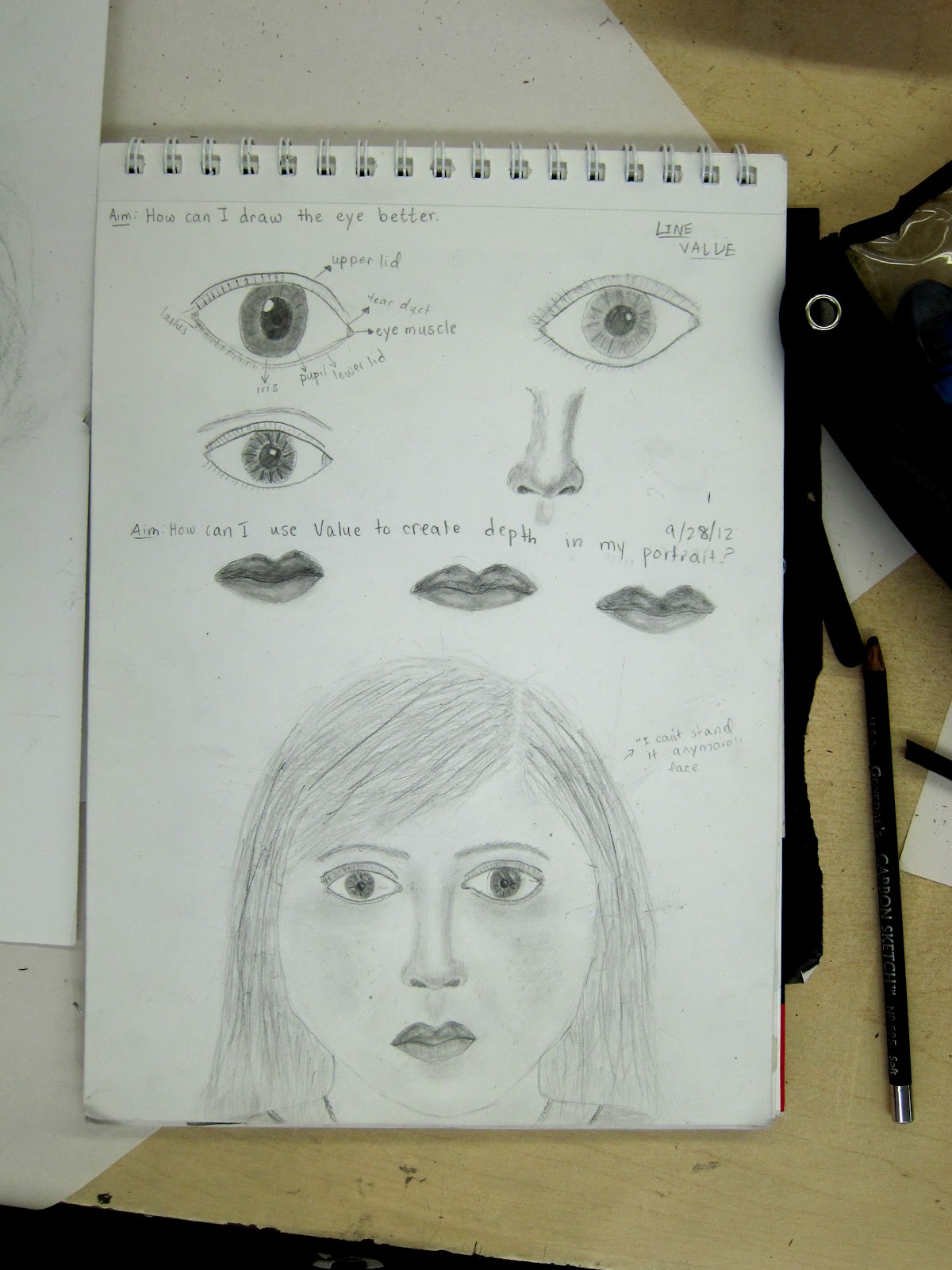
Students observed several demonstrations on how to measure and place the features in the correct spot on the face and practiced drawing Proportion guidelines to obtain accurate relationships in size and placement with the features. Additionally, we viewed several videos on how to draw the nose, basic proportions of the face and how to use charcoal to create a variety of values and textures to make the face look 3-dimensional on a flat piece of paper.
-->
Pivotal questions we will explore in class include:
What is a portrait?
Why do artists paint portraits?
What are the guidelines and measurements to achieve proportion when drawing the face and its features?
How can you create depth with value in your portrait?
Where are the significant highlights and shadows in the face?
What details and Elements of Art can you incorporate to make your work
more realistic?
What are different approaches and styles in portraits and self-portraits
throughout history?


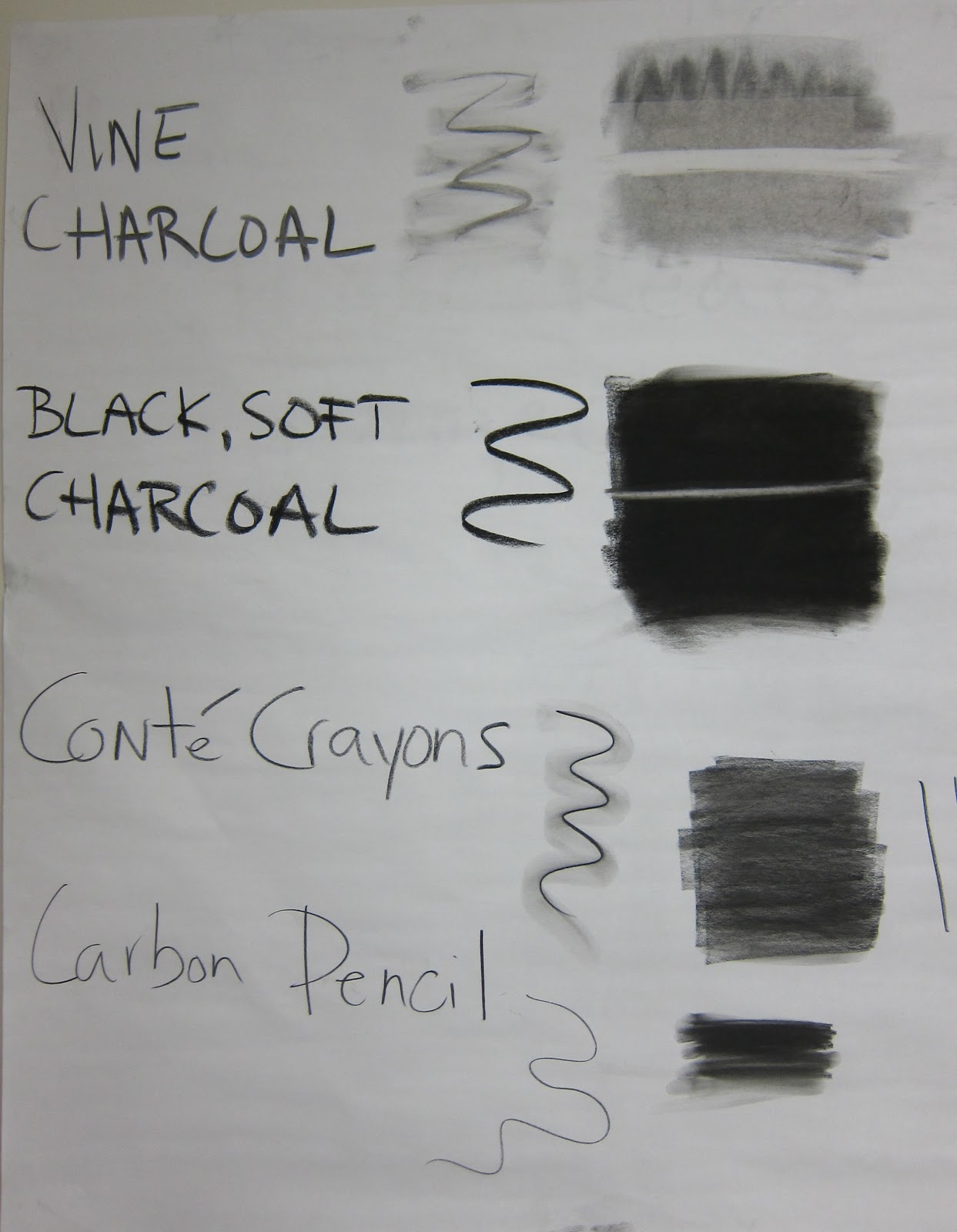
About Drawing Pencils


Grade 6: Experimenting with Line


In September, grade 6 students  reviewed The Elements of Art and focused on the Element of Line and all its possibilities. Students learned about the properties of their graphite/drawing pencils, as well as learned about blending stumps and erasers to create Value and Texture in their drawings. Students created Nonobjective Line drawings that explored Line and how to create an interesting composition with Repetition that incorporated Value, Texture, Space and Shape. Below are examples of student work completed on 12 x 12 inch drawing paper with  graphite pencils.


Wednesday, September 12, 2012

Tuesday, September 11, 2012

Long-Lost Picasso Discovered and Too Expensive to Keep

Check out the story... "In the southwestern Indiana town of Evansville, people are a bit baffled after hearing that the town's Museum of Arts, History and Science has had a rare Pablo Picasso piece in storage for almost half a century. Curator Mary Bower says the work went unnoticed because of a clerical error."
http://www.npr.org/2012/09/10/160132025/for-museum-long-lost-picasso-is-too-costly-to-keep

Tuesday, August 28, 2012

2012-2013 School Year

Studio Art: Grade Six and Seven

Overview
Studio Art is a full-year course that meets every other day for 40 minutes and follows the alternating A/B schedule for the entire school year. Grade 6 and 7 students explore materials and the art making process, art literacy, making interdisciplinary connections, art history and careers in the arts in a hands-on studio environment. The curriculum for grade 6 and 7 follows The Blueprint for the Arts developed for New York City and is aligned with National Art Education Standards. The sequence of skills, techniques and projects we explore in class build a strong art education foundation and makes valuable interdisciplinary connections.

My philosophy is to cultivate students individual art aesthetic and build on their analytic and problem solving ability that will challenge and enable students to develop a full range of tools to utilize in their personal expression in the visual arts. The Art Department produces annual art exhibitions to celebrate student work and achievement and students have opportunities to compete in art competitions outside of school like the Scholastic Art awards.

Grade 6 and 7 artwork will be showcased on this website, as well as resources and standards in art education. Visiting this website is a great way to see what your child is learning in class and see examples of projects created in class.

Rubrics and assignments can be found on www.eboard.com

All grade 6 and 7 students are required to have a sketchbook throughout the year for drawing and taking notes, which is checked periodically in class and part of a students grade. Students can store their art supplies in the classroom and are expected to have their sketchbooks with them in class. Larger art projects are graded based upon rubrics developed for each project, which is handed out to students. This allows students to see the criteria they need to complete in order to achieve success. There is homework assigned in Studio Art class but the majority of the artwork is created and completed in class. Lastly, students have jobs and responsibilities in the Studio Art room that is part of their daily grade for participation and performance in class.